Particle (Basic ㊦ 250)
A marker which indicates emphasis.
Equivalent: Even; as many/much/long/...as; (not) even (one); (not) any
| (i) Quantifier | も | |
| 五十も | As many as fifty | |
| 百人も | As many as a hundred people | |
| (ii) One Counter | も | |
| 一人も | (not) even one person | |
| 一つも | (not) even one ~ | |
| (iii) WH-word | も | |
| 何も | (not) anything | |
| 誰も | (not) anybody | |
| (iv) Vます | もしない | |
| 話しもしない | Don’t even talk | |
| 食べもしない | Don’t even eat |
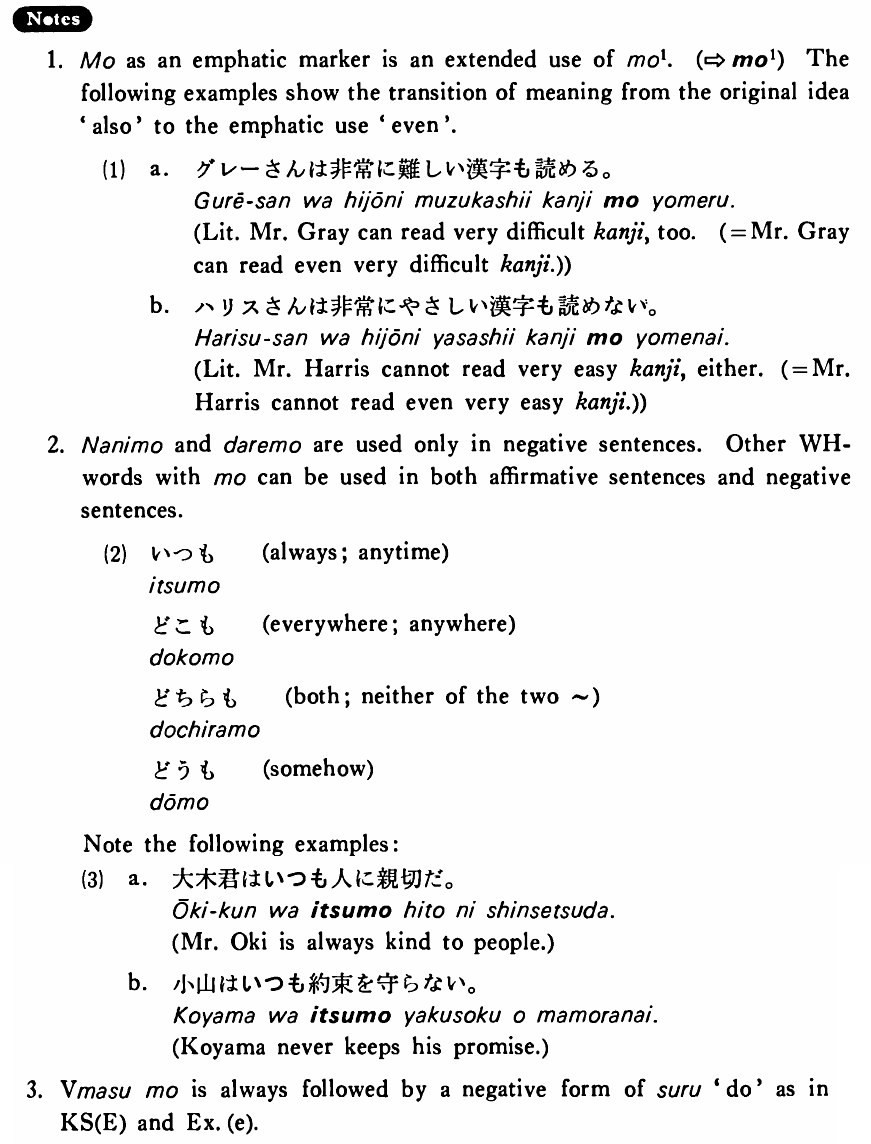
1. も as an emphatic marker is an extended use of も1. (⇨ も1) The following examples show the transition of meaning from the original idea 'also' to the emphatic use 'even'
2. 何も and 誰も are used only in negative sentences. Other Interrogative words with も can be used in both affirmative sentences and negative sentences.
Note the following examples:
3. Verbますも is always followed by a negative form of する 'do' as in Key Sentence (E) and Example (e).